

Brazil is rebuilding its consumption taxes from the ground up, and at the same time it started taxing dividends paid abroad. A company opened today will live through the whole transition, so the choices you make at incorporation carry further than they used to.
In brief
- Taxes being replaced
- PIS, COFINS, IPI, ICMS, ISS
- New taxes
- CBS, IBS and Selective Tax
- Transition
- 2026 to 2033
- Dividends paid abroad
- 10% withholding since 2026
- CBS (federal) and IBS (state and municipal) form a dual value-added tax with broad credits and taxation at destination.
- 2026 is a test year; CBS replaces PIS and COFINS in 2027; ICMS and ISS are phased out between 2029 and 2032.
- Companies with a partner domiciled abroad still cannot use Simples Nacional.
- Activity codes, location, tax regime, contracts and invoicing systems should be decided with the transition in mind.
The transition timeline
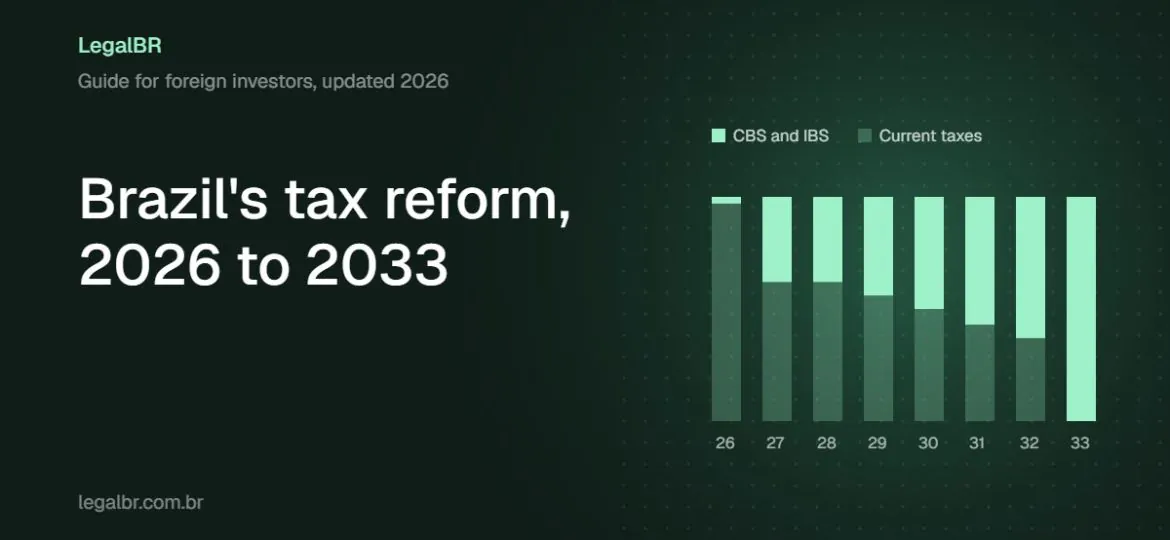
The reform was approved as Constitutional Amendment 132/2023 and regulated by Complementary Law 214/2025. Instead of switching overnight, Brazil runs the old and the new systems side by side for several years:
2026: test year
CBS at 0.9% and IBS at 0.1% are shown on invoices alongside the current taxes. Companies that meet the ancillary obligations are exempt from paying them in this phase, which is designed to test systems and calibrate rates.
2027: CBS in full
CBS is charged at its full rate and PIS and COFINS are extinguished. IPI rates are reduced to zero for most products, and the Selective Tax (Imposto Seletivo) starts on goods considered harmful to health or the environment.
2029 to 2032: gradual shift
ICMS and ISS rates are reduced to 90%, 80%, 70% and 60% of their levels, while IBS increases correspondingly.
2033: new system complete
ICMS and ISS are extinguished. CBS and IBS operate in full.
From the current taxes to CBS and IBS
How CBS and IBS work
CBS and IBS share the same rules on what is taxed, who pays and how credits work; the difference is who receives the revenue. CBS goes to the federal government, and IBS is shared by states and municipalities through a national management committee.
| Feature | Before the reform | After the reform |
|---|---|---|
| Number of taxes | Five, with different rules | CBS, IBS and the Selective Tax |
| Credits | Restricted, especially for services | Broad credits on business purchases |
| Where tax is due | Largely at origin | At destination, where the customer is |
| Rate setting | Thousands of state and municipal rules | One reference rate, with defined reductions |
| Collection | Self-assessment | Self-assessment, with split payment being introduced |
The combined standard rate is calibrated during the transition and is expected to be among the highest value-added tax rates in the world. In exchange, the tax is designed to be neutral along the chain: businesses recover the tax paid on what they buy and the burden lands on final consumption. The law also sets reduced rates for specific sectors, such as health, education and certain regulated professions, and a zero rate for the basic food basket.
What changes in practice
- Service companies. Many pay PIS and COFINS today on a cumulative basis, without credits. Under CBS and IBS they gain credits but face a higher nominal rate; the net effect depends on margins and on how much they buy from other businesses.
- Location. With IBS due at destination, state tax incentives lose weight in deciding where to set up. Logistics, talent and customers matter more.
- Invoices and systems. Electronic invoices already carry CBS and IBS fields. Billing and ERP systems need to calculate both systems during the transition.
- Cash flow. Split payment moves collection to the moment of payment, which changes working capital for companies that rely on paying tax only after receiving from customers.
- Double work until 2032. For several years companies calculate the old and the new taxes at the same time. Budget for more compliance effort, not less.
Exports, imports and services from abroad
For international groups, the cross-border rules are where the reform touches the business model directly:
- Exports of goods and services are relieved of CBS and IBS, and the exporter keeps the credits on its purchases.
- Imports of goods and services are taxed, so that Brazilian and foreign suppliers compete on equal terms. Services contracted from a foreign group company, such as management, software or licenses, should be reviewed with this in mind.
- Intercompany pricing agreed before the reform may need to be revisited, since the tax cost of cross-border services changes over the transition.
Income tax and dividends
The consumption tax reform does not replace corporate income tax. Companies with a partner domiciled abroad cannot opt for Simples Nacional, the simplified regime for small businesses (Complementary Law 123/2006, article 17), so they choose between presumed profit (Lucro Presumido) and actual profit (Lucro Real) for corporate income tax and social contribution (IRPJ and CSLL).
A separate change affects foreign shareholders directly. Law 15,270/2025 introduced a 10% withholding income tax on profits and dividends paid to shareholders resident abroad, starting in 2026. Profits for periods up to 2025 kept the previous exemption, provided their distribution was approved by 31 December 2025 and paid within the deadlines set by the law. Tax treaties and the specific rules of the law should be reviewed for each group.
Five decisions at incorporation
Activity codes (CNAE)
They determine licenses, municipal registration and how the tax authorities classify your operation, including access to reduced rates.
Head office and establishments
With destination taxation, choose locations for operations and talent rather than for local incentives that are being phased out.
Tax regime
Lucro Presumido or Lucro Real, chosen with your accountant considering margins, credits and the transition years.
Contracts
Long-term contracts signed now should state how prices adjust when the tax burden changes between 2026 and 2033.
Systems
Make sure the invoicing tool supports CBS, IBS and split payment before the first sale.
Once the apostilled documents arrive in Brazil, our team typically has the company ready to operate within 15 to 30 days, unless a specific license is required. Check your route in the Brazil Entry Planner.
Questions investors ask
When does the new tax system start?
CBS and IBS appear on invoices at test rates in 2026. CBS is charged in full from 2027, ICMS and ISS are phased out between 2029 and 2032, and the new system is complete in 2033.
Can a foreign-owned company use Simples Nacional?
No. A company with a partner domiciled abroad cannot opt for Simples Nacional. It is taxed under Lucro Presumido or Lucro Real.
Are dividends paid abroad taxed?
Since 2026, Law 15,270/2025 applies a 10% withholding income tax on profits and dividends paid to shareholders resident abroad, with transition rules for profits up to 2025. Tax treaties should be reviewed case by case.
Are exports taxed by CBS and IBS?
Exports of goods and services are relieved of CBS and IBS, and exporters keep the credits on their purchases. Imports of goods and services are taxed.
Should I wait for the reform to finish before investing?
Not necessarily. The rules and timeline are set in law. What matters is structuring the company, contracts and systems with the transition in mind from the start.